

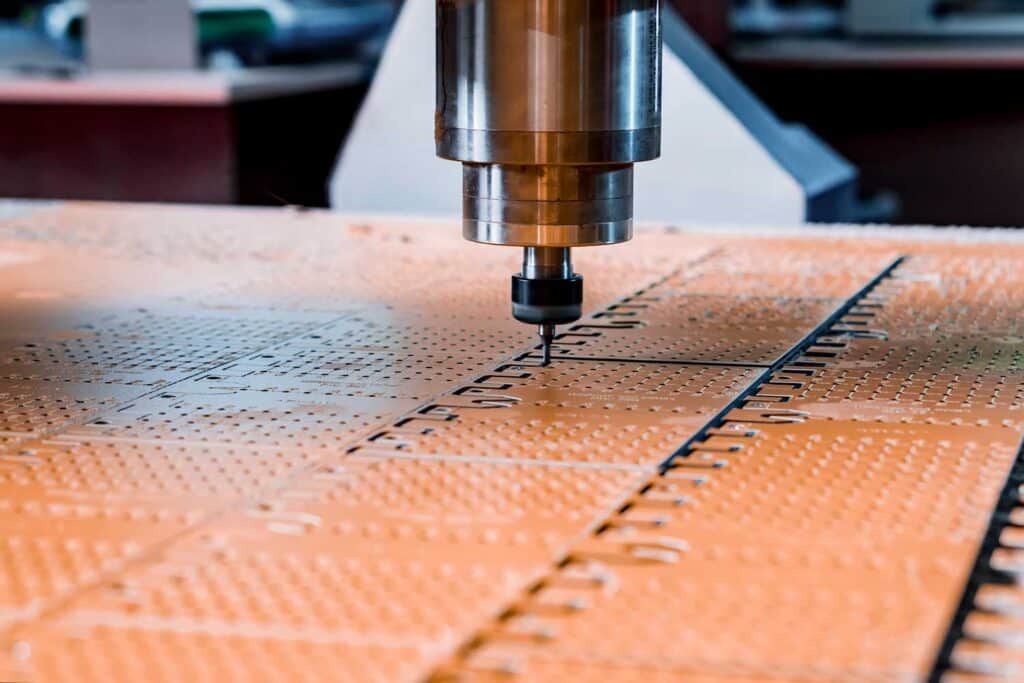
What You Need to Know About CNC Fabrication for Non-Metallic Materials
For many manufacturers and OEMs, CNC fabrication is the bridge between concept and full-scale production.
During early production or when designs continue to evolve, CNC fabrication can be an effective manufacturing method for components and gaskets made from plastics, foam, rubber and composite materials.
Using computer-controlled routing and knife-cutting equipment, CNC systems produce accurate, repeatable parts directly from CAD files. Because dedicated hard tooling is not required, manufacturers can move quickly from design to production while allowing flexibility for engineering changes.
This makes CNC fabrication particularly well suited for rapid prototypes and applications where precision and adaptability are critical.
CNC techniques for non-metallic materials
CNC fabrication is especially effective for non-metallic materials because cutting parameters can be adjusted based on the characteristics of the material being processed.
Cutting speed, feed rate, tooling and tool path all influence dimensional stability, edge quality and finished part performance. Selecting the appropriate CNC process helps minimize issues such as heat buildup, tearing, compression or material displacement.
CNC routing
CNC routing is commonly used for rigid materials such as plastics and composites.
Because many plastics are sensitive to heat, routing parameters must be carefully controlled to prevent melting, edge deformation or surface damage. Properly balancing feed rate, spindle speed and tooling geometry allows chips to carry heat away from the cutting area rather than allowing excessive friction to build.
The result is improved edge quality, dimensional accuracy and surface finish. CNC routing also provides the flexibility to manufacture larger and thicker plastic components without the cost and lead time associated with complex hard tooling.
Common materials include plastics and composites.
CNC flash cutting
CNC knife or flash cutting is commonly used for softer, flexible materials such as foam, rubber, silicone and layered adhesive constructions.
Using oscillating or drag blades, this method slices cleanly through substrates while minimizing compression and material displacement that can affect part fit.
For laminated materials, such as foam combined with pressure-sensitive adhesive, CNC cutting can help maintain layer alignment and produce consistent dimensions throughout the finished component.
Common materials include foam, rubber and silicone, often laminated with pressure sensitive adhesive, and other flexible materials.
Benefits of CNC Fabrication
Precision manufacturing
CNC equipment provides precise control over cutting paths and dimensions, making it well suited for complex geometries and applications requiring close tolerances.
Depending on the material, thickness and part design, CNC fabrication can achieve very tight tolerances while maintaining repeatable production from part to part.
Consistency & repeatability
CNC fabrication produces identical parts with high repeatability, reducing waste and rework. It places less stress on the material, with vacuum suction to hold it in place during the cutting process. Reliable production of foam, plastic and composite components at the front end supports higher product quality, which means less maintenance and better performance for the end user.
Design flexibility
One of the greatest CNC fabrication benefits is the ability to accommodate design changes without creating new hard tooling. With CNC fabrication, you can easily accommodate prototypes, design revisions and short production runs without disrupting your development schedule. Updates can be implemented through simple CAD changes, eliminating the added lead time and expense of new hard tooling.
Reduced material waste
Advanced nesting techniques in CNC fabrication maximize the number of usable parts from each sheet of material, improving material utilization and lowering overall production costs.
Scalable production
CNC fabrication can also serve as a bridge while permanent tooling is being developed, modified or validated.
Manufacturers can continue producing parts while tooling progresses, helping keep development and production schedules moving forward.
Once volumes increase or the design is finalized, production can transition to another manufacturing process when appropriate.
Quality control
Using a CNC process can improve quality control in several practical ways, especially for plastics, foam, rubber, and composites.
- Repeatability: Parts are produced from the same CAD program and cutting path, helping maintain consistent dimensions from part to part.
- Dimensional accuracy: CNC equipment can hold close tolerances when the material, tooling, and process are properly controlled.
- Reduced operator variation: Once the program and setup are validated, the process is less dependent on manual cutting or operator technique.
- Controlled cutting parameters: Feed rate, spindle speed, blade speed, and tool path can be standardized to reduce melting, tearing, compression, or edge distortion.
- Consistent material positioning: Vacuum hold-down systems help keep sheet materials stable during cutting, reducing movement and dimensional variation.
- Cleaner edges and finishes: Proper CNC settings can reduce burrs, chip welding, rough edges, and other defects that may lead to scrap or rework.
- Digital traceability: CAD files and machine programs create a repeatable manufacturing reference, making revisions and process control easier.
- First-piece and in-process inspection: CNC parts can be checked against the CAD dimensions before a production run continues, helping catch issues early.
When to choose CNC fabrication
CNC fabrication excels in situations where precision, flexibility and material performance are prioritized over the benefits of high-volume tooling.
CNC fabrication is often the right choice when:
- Parts are manufactured from plastics, foam, rubber or composite materials that require controlled cutting methods
- Product designs are still evolving and engineering revisions are expected
- Prototypes or pilot runs are needed before investing in permanent tooling
- Tight tolerances or complex geometries are required for proper fit and assembly
- Laminated or multi-layer materials must remain aligned during fabrication
- Production must continue while hard tooling is being developed or modified
- Material utilization and scrap reduction are important cost considerations
Partner with a precision expert
Successful CNC fabrication involves more than simply cutting a part from a CAD file. Material selection, cutting parameters, nesting and production strategy can all affect part quality and overall manufacturing cost.
Working with an experienced fabrication partner early in the development process can help improve manufacturability, material utilization and the transition from prototype to production.
Climatech supports OEMs with CNC routing and cutting capabilities with a wide range of non-metallic materials, backed by material selection, adhesive lamination, prototyping, engineering support and scalable production solutions.
Reach out to Climatech to discuss your project or get a quote.
FAQs about CNC fabrication for non-metallic materials
What is CNC fabrication for non-metallic materials?
CNC fabrication uses computer-controlled cutting methods to shape plastics, foam, rubber and composite materials with high precision. Parts are produced directly from CAD files, allowing accurate, repeatable fabrication without the need for hard tooling.
What materials can be fabricated using CNC cutting?
CNC fabrication is commonly used for polycarbonate, polyethylene plastics, composite materials, foam, rubber, silicone and laminated adhesive constructions. The cutting technique is selected based on material rigidity, thickness and performance requirements.
When is CNC fabrication preferred over die cutting or molding?
CNC fabrication is often preferred for rapid prototypes, short production runs, bridge production and applications where designs are still being refined. Because dedicated tooling is not required, engineering changes can be implemented quickly without producing new dies
How accurate is CNC fabrication?
CNC fabrication can achieve very tight tolerances, depending on the material, thickness, geometry and cutting process. This precision makes CNC manufacturing well suited for components requiring consistent fit and repeatable assembly.
Why is CNC fabrication well suited for plastics and foam?
Non-metallic materials are sensitive to heat, compression and tearing. CNC systems precisely control feed rate, cutting speed and tool paths to minimize material distortion, prevent melting and maintain dimensional stability.
What is the difference between CNC routing and CNC knife cutting?
CNC routing uses rotating cutting tools (router bits) and is typically used for rigid materials such as plastics and composites. CNC knife cutting uses oscillating or drag blades to cut flexible materials such as foam, rubber, silicone and adhesive laminates with minimal compression or material displacement.