

How Vibration Damping Materials Improve Industrial Equipment Performance
Vibration is a common challenge for OEMs and industrial equipment manufacturers. Mechanical energy traveling through machinery, components and surrounding structures can create unwanted movement, noise and wear that affect both equipment performance and the operating environment.
Unmanaged vibration can contribute to:
- Increased stress and friction on critical components
- Premature wear or failure of bearings, seals and fasteners
- Increased maintenance requirements and unplanned downtime
- Transfer of noise and vibration into floors, walls and adjacent equipment
- Louder and less comfortable working environments
- Increased risk of employee exposure to potentially hazardous noise levels
OSHA establishes an 8-hour permissible exposure limit of 90 dBA for occupational noise and an 85 dBA action level for general industry hearing conservation programs.
The right combination of vibration damping materials, isolation and structural design can help control these effects while improving equipment durability and performance.
Three Approaches to Industrial Vibration and Noise Control
Effective vibration control starts with understanding where vibration originates and how that energy travels through the equipment. Engineers generally use three strategies—often in combination:
Dampen: Damping materials such as elastomers, foams and viscoelastic polymers absorb vibrational energy and dissipate much of it as low-level heat, reducing resonance and vibration amplitude.
Isolate: Pads, mounts, bushings and other isolating components interrupt the transmission path between the vibration source and surrounding structures, reducing vibration transferred into frames, floors, housings and adjacent equipment.
Stiffen: Increasing structural rigidity can change a component’s natural frequency and move it away from problematic resonance ranges. Reinforced structures, engineered plastics and composites can help reduce unwanted movement and vibration response.
What Materials Are Used for Industrial Vibration Damping?
There is no single vibration damping material that is best for every application. The right choice depends on vibration frequency, loading, temperature, compression, environmental exposure and equipment design.
| Material | Key Benefits | Common Uses |
| Sorbothane® | Proprietary viscoelastic polyurethane designed for shock absorption, vibration isolation and damping. According to the manufacturer, it can absorb nearly 95% of shock energy and reduce more than 50% of vibration energy in certain applications. | High-load or sensitive applications where controlling shock and transmitted vibration is critical |
| Polyurethane Foams | Provide vibration damping, impact absorption, cushioning and recovery after repeated compression. Available in different densities and cell structures. | Gaskets, pads, spacers, equipment enclosures and housings |
| PET / Polyester Fiber Mats | Lightweight, moisture-resistant acoustic material that helps absorb airborne frequencies. | Internal cavities, acoustic blankets and equipment enclosures |
| Closed-Cell Polyethylene Foam | Resists moisture while providing cushioning, thermal insulation and high-frequency noise control. | Marine, outdoor and moisture-exposed equipment |
| Silicone Foams & Sponges | Combine vibration control with resistance to elevated temperatures and environmental exposure while maintaining flexibility across a broad temperature range. | High-temperature equipment, gaskets, seals and cushioning components |
| Neoprene & EPDM | Neoprene provides vibration control and resistance to oils and abrasion. EPDM offers excellent resistance to weathering, ozone, moisture, UV and heat. | Gaskets, seals, pads, bushings, motor mounts and weatherstripping |
| Mass-Loaded Vinyl (MLV) | Combines flexible PVC with dense mineral elements such as barium sulfate to create a thin, flexible sound barrier that helps block airborne noise and reduce vibration transfer. | Equipment enclosures, housings and space-constrained noise-control applications |
Material selection is only part of the solution. How the material is fabricated and incorporated into the equipment can be equally important.
Common Applications for Vibration Damping Materials
Sound-Deadening Pads
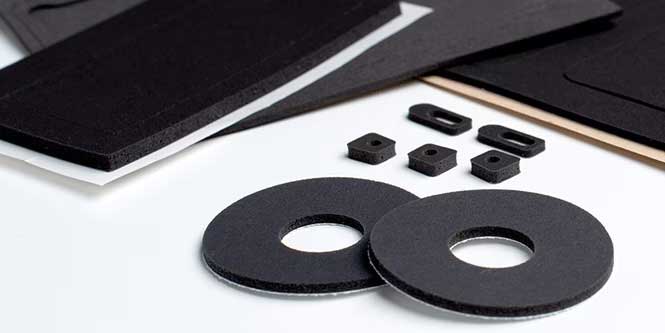
Sound-deadening pads made from viscoelastic materials, elastomers or engineered foams can be applied directly to equipment panels, housings and enclosures. Available with or without pressure-sensitive adhesive, they can be precision cut to reduce panel resonance, structure-borne vibration and radiated noise.
Gaskets and Seals
Die-cut elastomeric gaskets and seals can serve multiple functions within the same component. In addition to protecting against dust, moisture and contaminants, the right material can cushion mating surfaces, reduce vibration transfer and limit movement and friction between components.
Viscoelastic Damping Components
Viscoelastic materials applied to sheet metal, panels, housings and other structures help dissipate vibrational energy. This reduces structural vibration and the noise that can radiate from vibrating surfaces.
Pads, Spacers and Isolation Components
Custom die-cut foam and elastomeric components can be positioned between assemblies or beneath individual components to reduce direct vibration transfer. Thickness, density, compression and load requirements can be engineered around the specific application.
Choosing the Right Vibration Damping Material
Effective vibration control requires more than simply placing a soft material between two components. The material and component design must match the operating conditions of the application.
Important considerations include:
- Vibration frequency and amplitude
- Static and dynamic loading
- Required compression and recovery
- Operating temperature
- Exposure to oils, chemicals, moisture or UV
- Flammability requirements
- Desired service life
- Material thickness and available installation space
- Adhesive and lamination requirements
- Component geometry and manufacturing tolerances
Evaluating these factors early in the design process can help OEMs develop a more effective and durable vibration-control solution.
Engineered Solutions for Industrial Vibration Control
Vibration may be unavoidable in industrial equipment, but its impact can be controlled.
At Climatech, we work with OEMs and manufacturers to turn vibration, noise and sealing requirements into precision-engineered components. Through material selection, precision die cutting, fabrication and adhesive lamination, our team can manufacture custom gaskets, seals, vibration damping pads, cushioning components and other non-metallic solutions designed to support quieter operation, reduced mechanical wear and long-term equipment performance.
Need help with a vibration or noise-control application? Contact Climatech to discuss your requirements and explore a custom-engineered solution.
FAQs About Industrial Vibration Damping Materials
What are vibration damping materials?
Vibration damping materials absorb and dissipate vibrational energy to help reduce resonance, noise, vibration transfer and mechanical wear. Common materials include elastomers, engineered foams and viscoelastic polymers.
How do vibration damping materials reduce noise?
Vibrating panels, housings and other components can radiate sound. Damping materials absorb and dissipate some of that vibrational energy, helping reduce structural vibration and resulting noise.
What is the difference between vibration damping and vibration isolation?
Damping reduces vibrational energy within a component or structure, while isolation reduces the amount of vibration transferred from one component or structure to another. Many applications use both.
Which materials are commonly used for industrial vibration control?
Common materials include polyurethane elastomers and foams, PET fiber mats, polyethylene foam, silicone foams and sponges, neoprene, EPDM and viscoelastic materials. Selection depends on load, temperature, vibration frequency, compression and environmental exposure.
Where are vibration damping materials used?
Common applications include sound-deadening pads, gaskets, seals, machinery interfaces, enclosure panels, housings, spacers, cushioning components and isolation components.
How do vibration damping materials help reduce mechanical wear?
By reducing vibration, movement and impact between components, damping materials can decrease repeated mechanical stress on bearings, fasteners, seals and surrounding components, supporting longer equipment life and reduced maintenance.